Sustainability
Is regenerative the new sustainable?
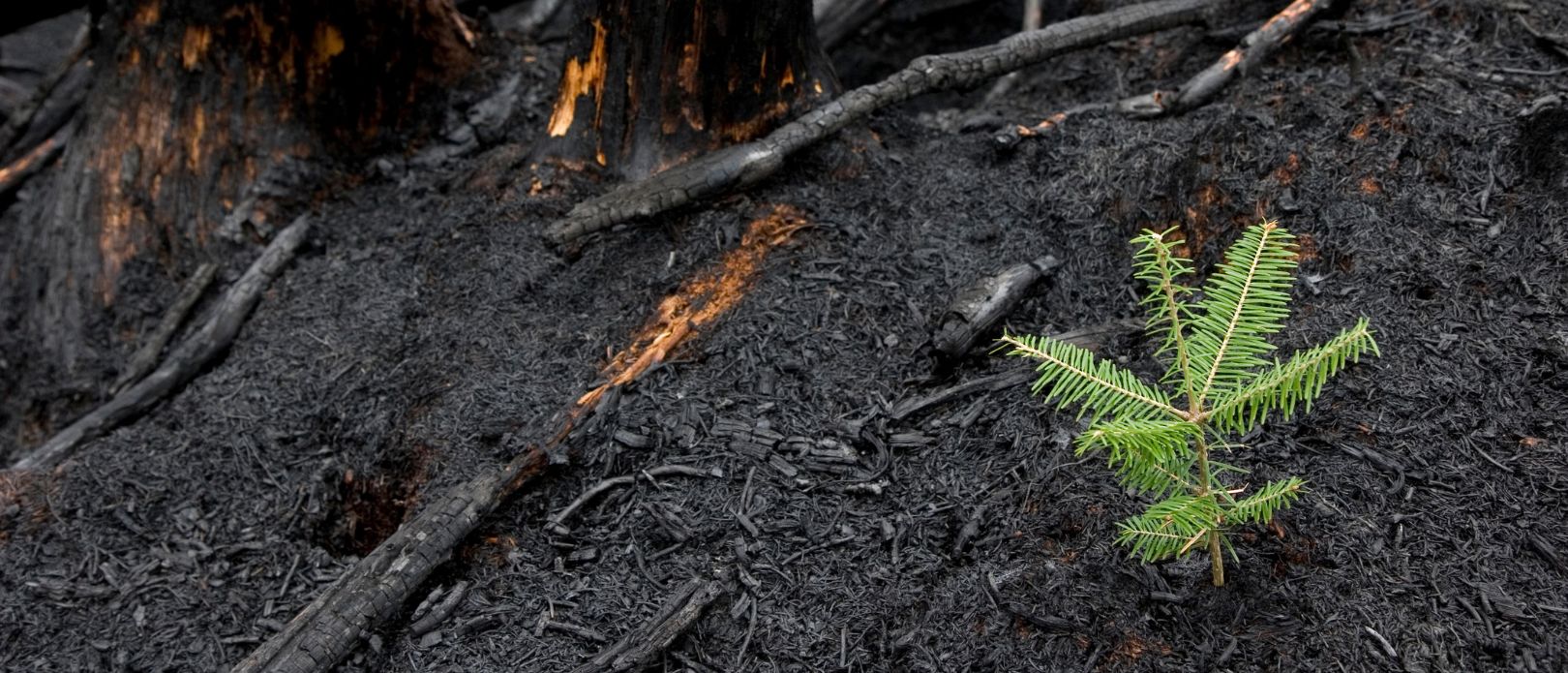
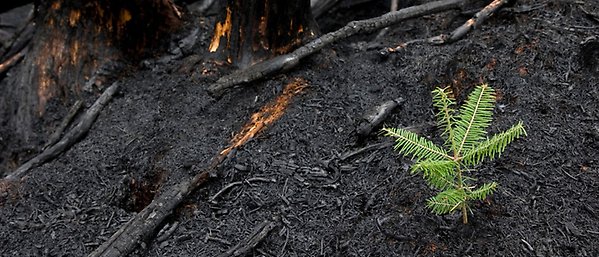
A tree growing back after a forest fire. Photo via canva.
A new paper by Centre founder Carl Folke and colleagues explores how the emerging concept of regeneration compares with resilience thinking. Could bringing the two together hold the key to shaping more sustainable futures?
In recent years, “regenerative” has become something of a buzzword in sustainability, appearing in everything from regenerative farming to regenerative business models. It refers to approaches that restore, renew, or enhance systems rather than simply reduce harm. Examples include rebuilding soils, increasing biodiversity, and improving social wellbeing.
The concept is also gaining traction in research fields such as sociology, economics, and management. Yet, within sustainability science it has not been as prominent, at least not in comparison with resilience, according to a new paper in Ambio authored by Carl Folke and researchers from Germany and Spain.
“While resilience thinking has been a central tenet of sustainability science for decades, a second body of literature on the concept of ‘regeneration’ has evolved in parallel, but so far with less influence,” they write.
The authors argue that the two concepts are highly complementary: while resilience thinking has traditionally focused on what enables systems to endure difficult times, the regenerative mindset is more about creating inherently healthy systems capable of continuous renewal.
“The focus [of regeneration] is less on averting the collapse of a much-cherished system, but instead on creating something new that is characterized by healthy dynamics from the outset,” they explain.
Some scholars have even suggested that regenerative could become “the new sustainable,” with a stronger focus on positive outcomes, agency, and mutualistic relationships between people and nature.
Drawing on insights from both bodies of scholarship, the authors outline seven principles that can guide proactive governance for resilient and regenerative futures:
- Respect planetary boundaries
- Seek to improve, not just sustain, the status quo
- Recognize and reinforce dynamics that maintain or recover desirable stable states
- Work with ongoing change and cross-scale interactions
- Maximize regenerative dynamics and minimize degenerative ones
- Foster mutualistic interactions between human and more-than-human entities (people and nature)
- Identify and enhance positive cross-domain interactions
The paper concludes that resilience and regeneration may together form the foundation for a new vision of thriving societies and ecosystems, guiding the transformation toward sustainability.
Fischer, J., Farny, S., Pacheco-Romero, M. & Folke, C. 2025. Resilience and regeneration for a world in crisis. Ambio, 55, p. 24-34.
-

Titanic can teach us how to protect nature
The voyage of the Titanic can help us understand how to better combat environmental degradation.
-
.png)
"Success comes from collaboration and pushing each other to be better ...
The message from the world leading sustainability researcher and co-founder of Stockholm Resilience Centre, is clear: there is but one planet that provides the foundations for life in the known universe, we humans need to take better care of it.