International Symposium
The Anthropocene at 25 – from concept to paradigm shift
.png)
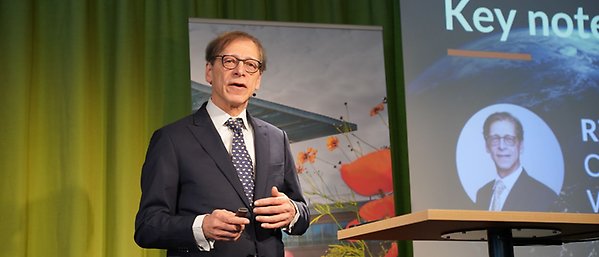
Centre director Line Gordon held the welcome address at the symposium. Photo by Patrik Lundin.
What does it mean to live in a world where humans dominate and reshape Earth on a planetary scale? This was the central theme of The Anthropocene Paradigm Shift, a one-day symposium held at the Royal Swedish Academy of Sciences.
The symposium was co-organised by the Centre together with the Royal Swedish Academy of Sciences, Future Earth, the Beijer Institute of Ecological Economics, the Anthropocene Laboratory, the Center for Anthropocene History at KTH, and the Bolin Centre for Climate Research.
In her welcome address, Centre director Line Gordon reflected on the legacy of Nobel Laureate Paul Crutzen, who first introduced the concept 25 years ago. The SRC itself, she noted, is “a child of the Anthropocene,” rooted in the idea that scientific insight must be matched by human ingenuity, care and respect. She also reminded the audience that the future of a liveable planet for humanity is inseparable from the remarkable diversity of life in the biosphere.
Wendy Broadgate, director of the Swedish Global Hub of Future Earth, dedicated the symposium to the late Will Steffen, the “father of Earth system science” and a long-time collaborator to and visiting researcher at the Centre. “His talent for engaging diverse communities, testing and developing the concept of the Anthropocene, triggered a wide adoption of the term as we know it today,” she said.
Deep into the Anthropocene
Opening keynotes stressed the urgency of the moment. Former Centre director Johan Rockström warned that humanity is “deep into the Anthropocene, there is no doubt,” as shown by the escalating transgression of planetary boundaries and weakening biosphere resilience. While the recent geological decision not to formalize the epoch has drawn attention, Rockström emphasised that “it does not really matter from an Earth system science perspective.”
The first session explored trajectories of the Great Acceleration. Katherine Richardson highlighted that the biodiversity crisis is “at least as important as the climate crisis” and called planetary boundaries “indicators of planetary health, similar to blood pressure in humans”. Buhm-Soon Park challenged Eurocentric narratives by bringing Asian perspectives into view, while Sarah Gabbott described plastics and other “technofossils” as geological signatures of modern consumption.
Cultural and historical dimensions took centre stage in a session led by Sverker Sörlin and Sabine Höhler. Helge Jordheim argued that humans live across “multiple times at once,” and that ecological and social rhythms have become increasingly out of sync. Jan Zalasiewicz and Jean-Baptiste Fressoz traced the rapid rise of technodiversity, energy use and material throughput that now define human–Earth interactions.
From geology to cognition
Talks on the Anthropocene as a scientific paradigm shift with perspectives from geology, Earth systems and science history followed. Colin Waters, Francine McCarthy and Alasdair Skelton guided the audience through the geological evidence – from plutonium fallout to temperature shifts, while Kim Cohen questioned how to time-stamp such a recent transformation with methods designed to reconstruct changes happening many thousands or million years ago. Fabienne Will and Kevin Noone also reflected on how the Anthropocene pushes science beyond disciplinary boundaries and into the realm of wicked problems.
In the final session, Centre researcher Michele-Lee Moore presented the new report “Human Cognition and the Anthropocene,” which reveals how the Anthropocene is shaping our brains and minds, and how our cognition and social systems are, in turn, driving global change.
Moreover, Luke Kemp, author of the book Goliath’s Curse, stressed extreme inequality as a root cause of Anthropocene pressures; Emilie Caspar examined the neuroscience of obedience; and Julia Steinberger argued for post-growth economic models. Last but not least, Deliang Chen discussed China’s evolving idea of an ecological civilization, while Frank Biermann reflected on the political power of science, technocratic fallacies, and the deeply unequal responsibilities that underpin the Anthropocene.
Humans in the biosphere
Closing the event, Carl Folke, Chair and founder of the Centre, said that the late Paul Crutzen and Will Steffen “would have been super happy with this day.” He emphasised that dealing with the many challenges of the Anthropocene requires a deep understanding of how intertwined people and nature are, that humans are embedded in the biosphere. He concluded by noting that we are in the midst of a cultural transformation with significant positive momentum: the future of our species and civilisation depends on decisions made now, and “it could go very bad, but also very well.”
.png)